eConsult Workload, Performance and Patient Experience Report
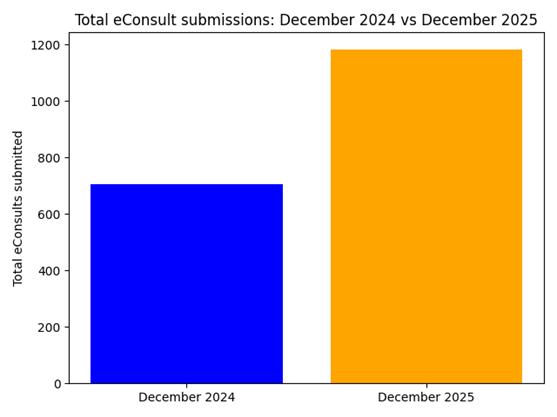
This report compares eConsult activity and patient experience between December 2024 and December 2025. Over this period, total eConsult submissions increased from 706 to 1,183, representing a 68% rise in workload.
Despite this significant increase in demand, patient satisfaction and reported outcomes improved. This coincides with the introduction of a GP-led daily triage model in early 2025, providing clearer clinical oversight and reassurance for patients.
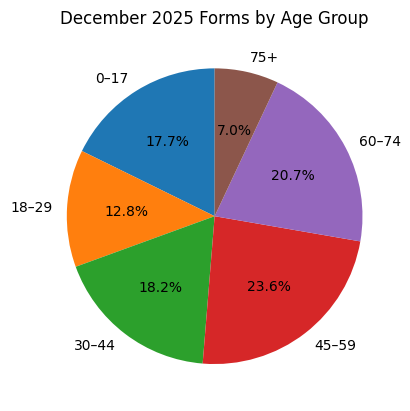
Analysis of age-profile data demonstrates increased uptake across all age groups, with the largest proportional growth seen among patients aged 60–74. This provides strong evidence that eConsult is increasingly used by older populations and supports its role as an inclusive digital access route.
Comparative analysis of December 2024 and December 2025 eConsult activity, patient feedback, and service delivery.
1. Background and purpose
This report provides a detailed comparison of eConsult usage and patient experience between December 2024 and December 2025. It is intended to support transparency for patients and operational understanding for practice staff. The report examines workload trends, patient satisfaction, and the impact of service changes introduced in 2025. In October 2025 the government made it mandatory to use an online triage platform and there was some publicity of this, however we had already being using this syem to triage patients.
2. Overview of eConsult usage
eConsult continues to be a key access route for patients seeking care. Usage data demonstrates a significant increase in demand year on year, reflecting both growing patient awareness of digital access and increasing reliance on online consultation as a method of managing demand.
In December 2024, the practice received a total of 706 eConsult submissions. In December 2025, this increased to 1,183 submissions. This represents an increase of 477 submissions, equivalent to a 68% increase in workload.
3. Managing increased workload
Despite the significant increase in workload, the service has continued to function safely and effectively. From Feburary 2025, the practice introduced a revised triage model whereby a GP is allocated each day specifically to triage eConsult submissions. This model was not in place during 2024 and other healthcare professionals were triaging the online forms.
The introduction of daily GP-led triage has enabled more consistent clinical oversight, faster decision-making, and clearer communication with patients. Importantly, patients are aware that a GP has reviewed their submission, which appears to have contributed to improved confidence and satisfaction.
4. Patient satisfaction and experience
Patient feedback data shows a clear improvement in experience and outcomes between December 2024 and December 2025, despite the increase in eConsult usage.
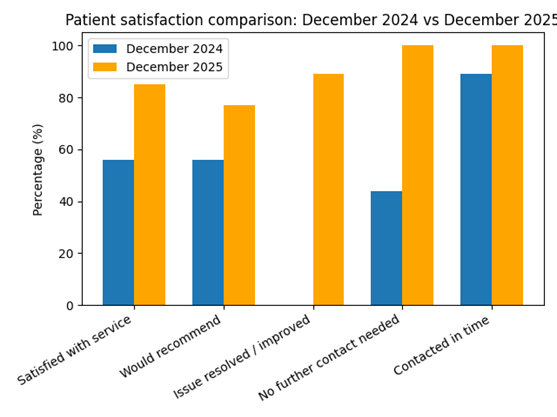
In December 2024, patient satisfaction and outcome measures were more mixed. It should be noted that the December 2024 survey results are based on feedback from 9 patients, and some respondents may not have answered the question relating to whether their issue was resolved or improved. This limits direct comparability for that specific measure.
By contrast, December 2025 patient feedback demonstrates higher satisfaction, improved reported resolution of issues, and a greater proportion of patients not requiring further contact with the practice or other health services.
5. What this means for patients
For patients, this report demonstrates improved access to care through eConsult, with clearer outcomes and more timely responses. The data suggests that patients benefit from knowing that their submission has been reviewed by a GP, contributing to increased reassurance and trust in the service.
6. What this means for staff and the wider system
For staff, the data highlights a substantial increase in digital workload. The successful management of this increased demand reflects changes in workflow, clinical oversight, and prioritisation. For the wider system, the findings suggest that digital access can absorb and manage demand effectively when supported by appropriate clinical triage models.
7. Conclusions and next steps
The comparison between December 2024 and December 2025 demonstrates that increased eConsult usage has been accompanied by improved patient satisfaction and outcomes. The GP-led daily triage model introduced in February 2025 appears to have been a key factor in supporting service quality during a period of increased demand.
Ongoing monitoring of workload, patient feedback, and staff capacity will remain important to ensure the sustainability of the service and continued positive patient experience.
Age Profile of eConsult Users
There have been concerns raised by patients that the older populations can’t use or have access to the internet. In the practice we have introduced 2 booths whereby anyone who has not got access to the internet can come in and complete an e-consult form and be given assistance to complete by a member of staff if needed. Age data has been grouped into standard age bands to assess changes in usage between December 2024 and December 2025.
| Age group | December 2024 | December 2025 | Percentage increase |
| 0–17 | 150 | 213 | 42.0% |
| 18–29 | 108 | 154 | 42.6% |
| 30–44 | 199 | 218 | 9.5% |
| 45–59 | 201 | 283 | 40.8% |
| 60–74 | 130 | 249 | 91.5% |
| 75+ | 57 | 84 | 47.4% |
The table and chart below demonstrate increased eConsult usage across all age groups. Notably, the largest proportional increase occurred among patients aged 60–74, with a 91.5% increase year on year. Usage among patients aged 75+ also increased substantially.
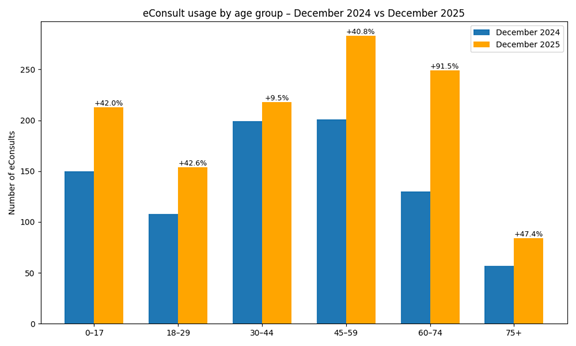
These findings challenge assumptions that digital consultation is primarily used by younger patients. Instead, the data shows that older populations are increasingly using eConsult. The GP-led daily triage model introduced in early 2025 may have contributed to this trend by providing reassurance that submissions are clinically reviewed.